A) strongly influenced by the firms in the very industry that it is regulating.
B) headed by bureaucrats who have a "lock" on their positions, without any rivals.
C) completely dominating and controlling the actions of firms in the industry.
D) headed by unelected government officials who have no strong desire to regulate.
F) B) and D)
Correct Answer

verified
Correct Answer
verified
A) government decision making.
B) actions by elected officials.
C) the impact of budget deficits on the public debt.
D) voting and elections.
F) B) and D)
Correct Answer
verified
Correct Answer
verified
A) Government-owned companies may have difficulty getting taxpayers and politicians to approve the funding needed to improve their facilities.
B) The health and safety laws appear to be applied much more leniently against government-owned companies than against private companies.
C) Government-owned companies tend to be run by less qualified and less competent managers than the private companies.
D) Government-owned companies are under less pressure to comply with the laws, because fines for violations are often delayed or even avoided.
F) A) and B)
Correct Answer
verified
Correct Answer
verified
B) False
Correct Answer
verified
Correct Answer
verified
A) de
B) da
C) ef
D) ab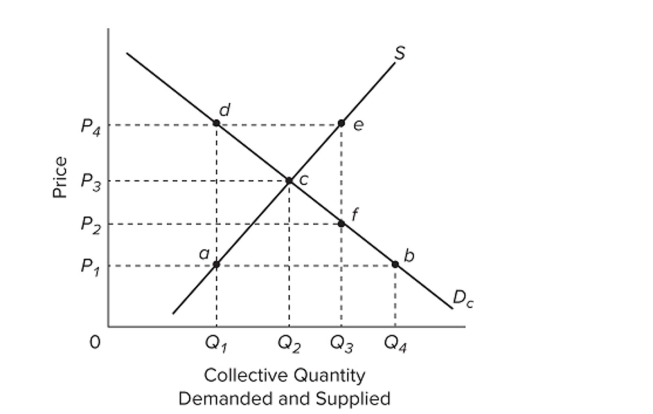
F) A) and C)
Correct Answer
verified
Correct Answer
verified
A) laptops used by students in a college or university.
B) movies produced by Hollywood companies.
C) bike paths around a city or town.
D) airline tickets bought by vacationers.
F) B) and C)
Correct Answer
verified
Correct Answer
verified
A) marginal bene?ts in excess of marginal costs.
B) fewer spillovers than either Plan A or Plan B.
C) an overallocation of resources to ?ood control.
D) an underallocation of resources to ?ood control.
F) B) and D)
Correct Answer
verified
Correct Answer
verified
A) a medium pizza.
B) a large pizza.
C) a super-large pizza.
D) two medium pizzas.
F) B) and C)
Correct Answer
verified
Correct Answer
verified
B) False
Correct Answer
verified
Correct Answer
verified
B) False
Correct Answer
verified
Correct Answer
verified
A) moral hazard problem.
B) principal-agent problem.
C) adverse selection problem.
D) common good problem.
F) None of the above
Correct Answer
verified
Correct Answer
verified
A) the paradox of voting
B) progressive taxation
C) proportional taxation
D) interest groups
F) A) and D)
Correct Answer
verified
Correct Answer
verified
A) 152 earmarks, totaling $3.3 billion.
B) 232 earmarks, totaling $14.7 billion.
C) 1,160 earmarks, totaling $19.6 billion.
D) 11,700 earmarks, totaling $16.9 billion.
F) A) and C)
Correct Answer
verified
Correct Answer
verified
A) be produced, because the benefits are greater than the costs.
B) not be produced, because the costs are greater than the benefits.
C) be put to a vote and produced only if voters approve it.
D) not be produced, even if voters vote in favor of it.
F) A) and D)
Correct Answer
verified
Correct Answer
verified
A) is derived in the same manner as demand curves for private goods.
B) is derived by horizontally summing all individual demand curves.
C) shows the total value that all individuals place on each additional unit of the good.
D) shows the total number of units that would be produced by the public sector at each possible price.
F) B) and C)
Correct Answer
verified
Correct Answer
verified
A) reduces the power of the median voter.
B) is the primary reason for public sector failure.
C) may produce economically inefficient outcomes.
D) creates the opportunity for the fallacy of limited decisions.
F) A) and C)
Correct Answer
verified
Correct Answer
verified
A) an inexpensive bouquet.
B) a very expensive bouquet.
C) a moderately priced bouquet.
D) an expensive bouquet.
F) None of the above
Correct Answer
verified
Correct Answer
verified
A) political logrolling.
B) the median-voter model.
C) the paradox of voting.
D) the principal-agent problem theorem.
F) A) and C)
Correct Answer
verified
Correct Answer
verified
A) defeat this project and resources will be underallocated to it.
B) pass this project and resources will be efficiently allocated.
C) pass this project and resources will be underallocated to it.
D) pass this project and resources will be overallocated to it.
F) None of the above
Correct Answer
verified
Correct Answer
verified
A) Rules and enforcement in an industry are heavily influenced by the industry being regulated.
B) One firm controls an entire market, having captured customers away from other firms.
C) Government imposes excessive regulations in an industry, resulting in inefficiencies.
D) Consumers make all the rules for an industry, forcing firms into inefficient production methods.
F) A) and B)
Correct Answer
verified
Correct Answer
verified
Showing 101 - 120 of 242
Related Exams